
This gallery contains 6 photos.

For the Kitchen Gardeners’ Society September workshop, the gardeners were delighted to be invited by the Glen Forrest Community Garden to put in some garden beds.
The Glen Forrest Community Garden is only just getting going, so this was a wonderful opportunity to help build a beautiful space for everyone to share.
 So far, there’s a few fruit trees there, some artichokes and some broccoli that isn’t doing too well.
The site gets the odd frost and it’s not protected, so the delicate little plants have suffered this winter.
But, as spring is here, it’s time to get some spring veg in.
Using lots of old newspapers and mulch, we all mucked in to put down paths.
Then, using the organic design method, we put in a raised bed for potatoes.
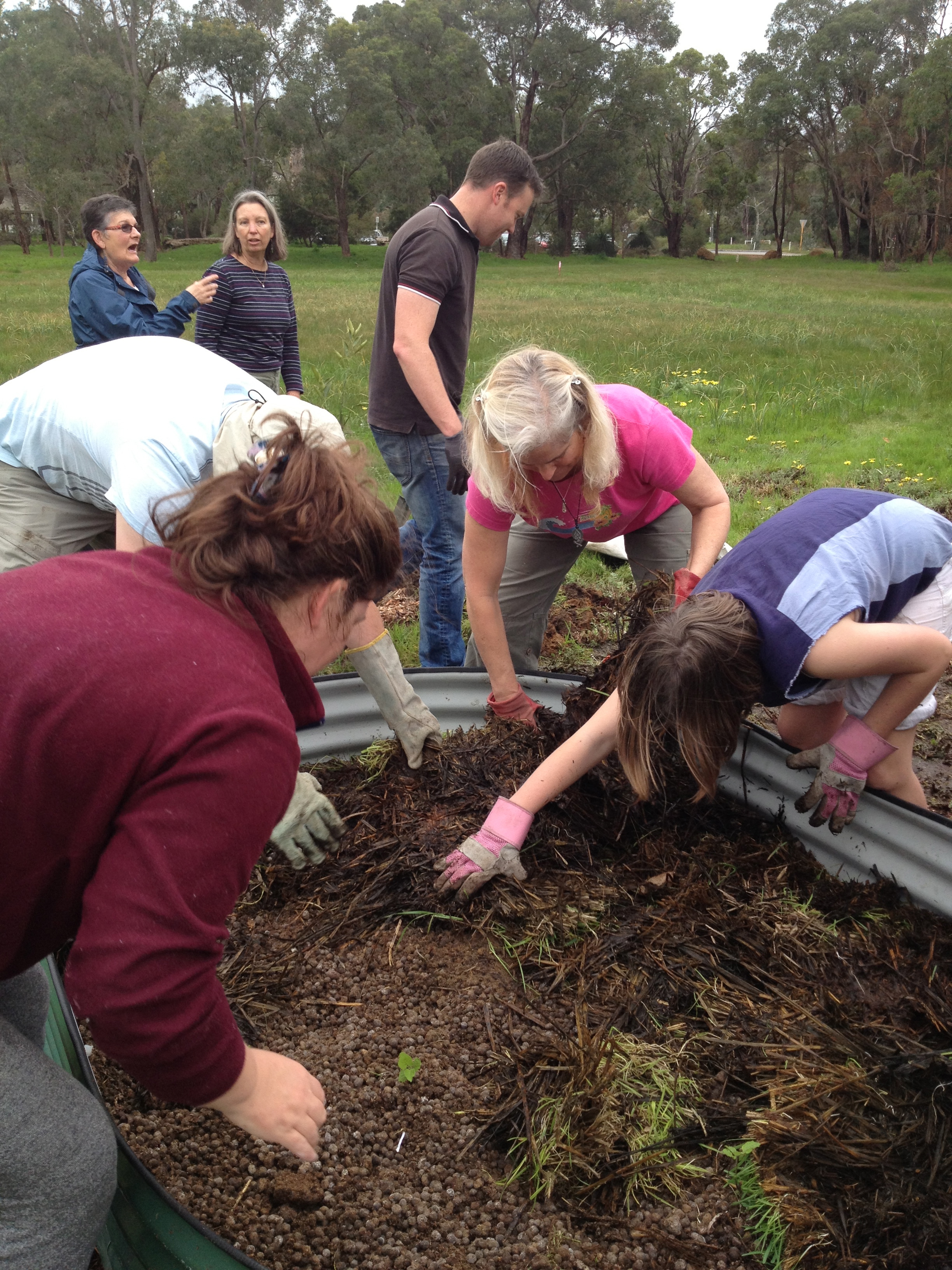 Kerry brought a stack of seed potatoes and some potato sprouts which we planted on layers of poo, rotting down straw and shredded paper.
Once the leaves appear, we’ll put another layer of straw and soil on top of the, forcing the plants to leave another layer of tubers, and grow taller.
With a bit of luck, there’ll be three or four layers of lovely potatoes in this bed.
Everyone is hoping the rabbits don’t find the garden and in a couple of months, there’ll be a lovely harvest of beans, tomatoes, corn, artichokes, broadbeans and lots of other veg.
 If you’ve got a couple of hours spare on a Sunday, there’s always something happening at the garden, corner of Hardey Road and Railway Parade in Glen Forrest.
You can keep in touch on facebook here.
Posted in Community, Event, Food, Kitchen Gardeners
Tagged Glen Forrest Community Garden, Growing food, Kitchen Gardeners
Lots of Kitchen Gardeners have talked about pruning their fruit trees with something akin to dread – the things that could go wrong! But pruning your apples and plums isn’t nearly as fraught as you might think.

Meet Rob. Rob grew up on a biodynamic farm long before it was fashionable. He has lots of amusing stories about dealing with the flummoxment of the experts from the Agriculture Department.
He’s pruned thousands of trees, starting when he was just a kid.
We were most grateful he agreed to share what he’s learnt about the care and maintenance of stone fruit, pome fruit and citrus.
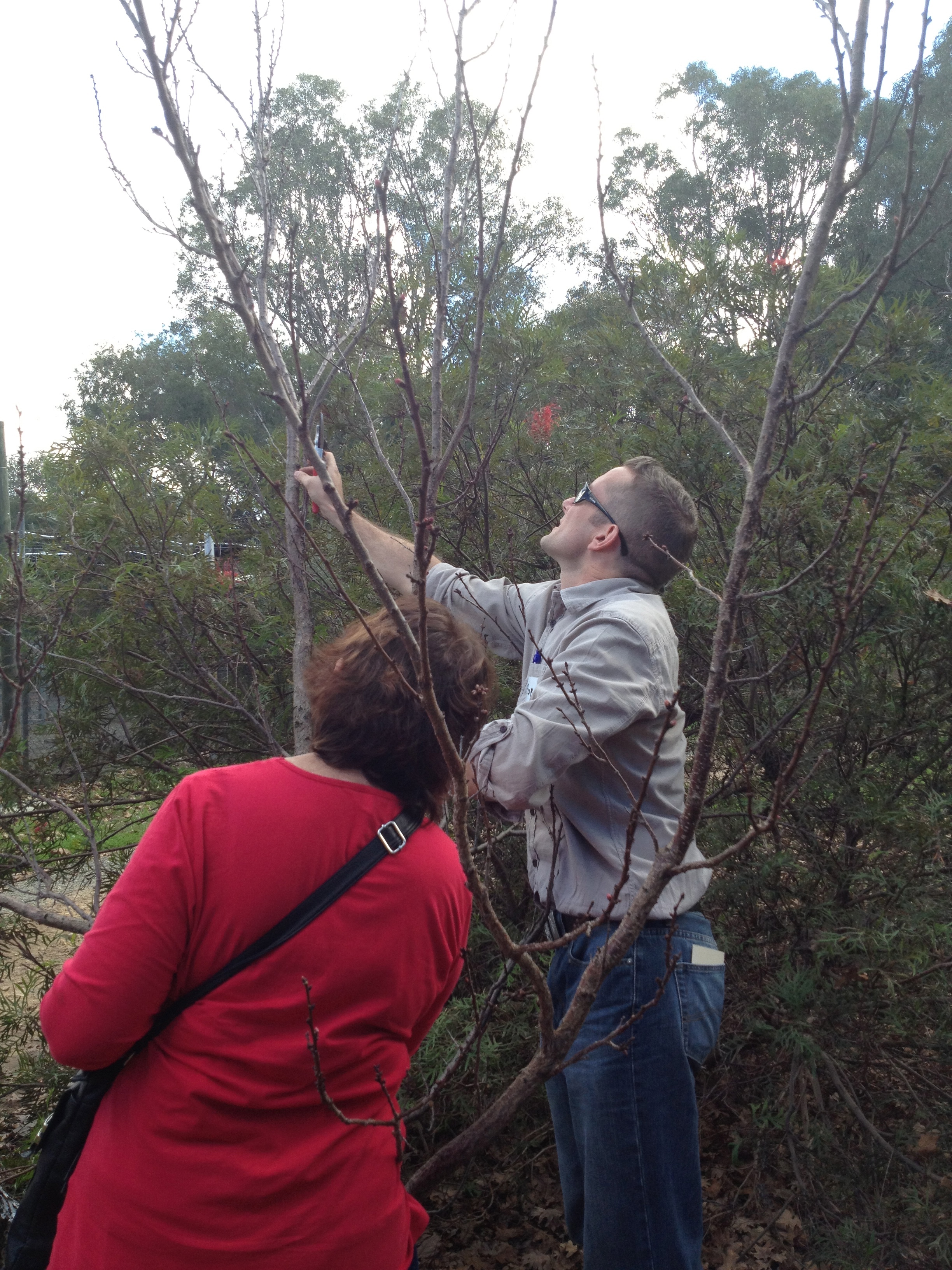 This is a very neglected apricot tree, probably not pruned for five years.
It’s grown into an odd shape, and it overhangs a driveway. While it’s healthy, it was not in a particularly good shape for fruit production, easy harvesting or good air-flow, which is important to reduce the likelihood of infestation or fungal infection.
The first principle Rob shared was that you can prune a tree any way you like but there will be consequences. If you take out old growth on a tree that fruits on old growth, you can expect a reduced yield the next season. Likewise if you want your tree to offer you shade, you should expect not to be able to reach the topmost fruit.
This apricot will fruit on new growth, and we could see flower and leaf buds just waiting to erupt.
Rob trimmed the tall branches back to a reachable height, took out boughs that crossed each other and created a funnel shape to encourage air-flow and ease of harvest. That meant taking out quite a bit of new growth, so there will be fewer fruit this year, but next year it should have a much larger yield.
 This citrus, on the other hand, is not in a good position. It doesn’t get enough direct sunlight and is competing also for water and nutrients with several other trees.
It has citrus leaf miner (spray with eco pest oil) and aphids (blast off with a jet of water from the hose).
Rob’s advice was to move it to give it the best chance of good growth and fruit.
Some other important things to remember:
Rob has agreed to do another pruning workshop next year, if you missed this one and are interested.
Posted in Event, Food, Kitchen Gardeners
Tagged DIY gardening, Gardening, Growing food, Kitchen Gardeners, sustainable food production




Community Garden in Glen Forrest Western Australia
Cultivating a strongly connected community and a healthy environment
Cultivating a strongly connected community and a healthy environment
The Economics of Happiness
We are the ones we've been waiting for
 Transition Town Guildford