Category Archives: Food

The pigness of the pig – Joel Salatin

If you’ve seen Fresh, Food Inc or any of the recent movies on our failing food system, you’ve probably seen Joel Salatin. He’s the charismatic USA farmer who’s got radical ideas on how to transform the way we produce food, and he’s put it into practice at Polyface farms.

As a self-confessed ‘Christian-Libertarian-Environmentalist-Capitalist-Lunatic Farmer’, he’s an interesting character. I was lucky enough to hear Joel speak in Byford in late 2012 and here are a few of his insights.

Many will be aware that our food system has become unsustainable, nutritionally lacking and actually unhealthy. Modern agriculture has become captured by a ‘fatter, faster, bigger, cheaper’ mentality.  As Joel pointed out

“We’re living in strange times when heritage ideas, like drinking raw milk, are considered hazardous, but it’s OK to drink coke and eat twinkies!”

Key to Joels method of farming is mimicking nature. He asks, “What’s nature’s template? How can we adapt and use it?” For example, all large grazers in nature are mobile and move in herds, followed by birds – think of buffaloes or deer. Therefore, he treats his cattle or ‘sauerkraut vats’ like buffalo. He moves them every day and allows them to feed in only a small area constrained by mobile electric fences. This ensures that they eat all the forage and not just the tasty palatable species. It also means that the grass lays dormant for much of the year and can regrow, recover and seed.

Following the cattle, Joel brings in hens in egg mobiles. The chickens pick through the cow pats and help to sanitize and spread the manure. While this farming method is more labor intensive, that’s actually a positive, it provides more employment. It’s also more financially viable. With multiple products and incomes stacked on top of each other, his farm produces several times the income per acre of his neighbours. Ultimately he’s not just a grazier or a chicken farmer, he’s a “Grass farmer”.

Joel with chickens behind super lite and portable electric fence

Joel with chickens behind super lite and portable electric fence

Following this approach, his pasture has improved considerably. He went from 1% organic matter in the soil to 8%! Therefore his soil has much greater water holding capacity.

While many of the ideas Joel promotes are aligned with Permaculture (e.g. aim to keep water as close to where it falls for as long as possible), he doesn’t call it that. Some more of his principles:

  • Tools must be multi use and ideally cheap
  • Get animals to do the work
  • Value waste (manure)
  • Nature sanitizes in 2 ways: rest and sunshine or compost

He was one of the most authentic and funny presenters I’ve heard, but what I also really liked about his workshop was that it wasn’t just about farming, it was really his philosophy of life. For example, talking about expensive farm equipment, “We capitalise our lives thinking it makes us free, but it enslaves us to that paradigm, financially and mentally”.

He also covered poultry and rabbit sheds, farm hand over, interns, marketing, sales and more. If you’re interested, you can listen to an audio recording of the entire day courtesy of Peter McMullen and Permaculture West (note 5.5 hrs).

Thanks also go to Heenan Doherty who brought him over. If you’re interested, they also sell the light weight electric fences Joel uses.

In case you missed it – preserving the harvest

There was rain, there was thunder and lightning and squally wind.  It was a dose of winter at the end of Spring, and it was NOT going to stop the Kitchen Gardeners holding their Preserving the Harvest workshop.

The plan had been to make marmalade, lemon curd, lemon cordial, tomato passata and Moroccan preserved lemons.  Well, four out of five is pretty good.

Tomatoes, ready for processing

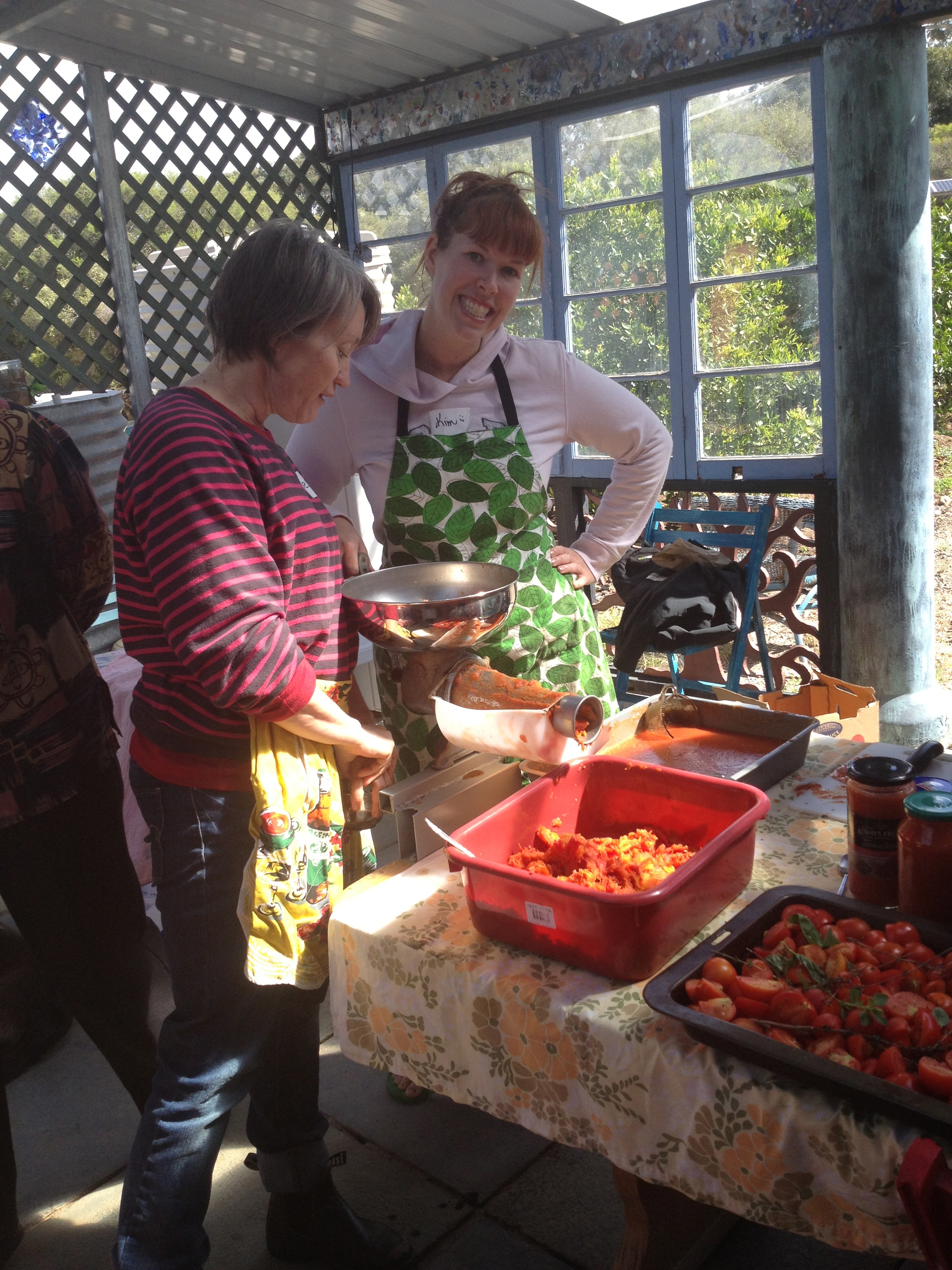
We managed to process something like 30kg of tomatoes into passata, flavoured with garlic, thyme and oregano.

We also made up a dozen or so jars of Debra’s microwave lemon curd (recipe at the end) and two batches of marmalade using Elizabeth’s Great-Nana’s guaranteed recipe (recipe also following).  Debra also made just enough lemon cordial for us all to try.

Sadly, we just didn’t get to the Moroccan lemons.  There was a bit of a jar issue and, well, we just ran out of time.  What with having to try two different kinds of marmalade, some experimental kiwifruit jam and the lemon curd on Peter’s turkish bread, you get the picture…

Bev and Kim with great piles of tomatoes

Debra’s microwave lemon curd 

  • 3 large eggs plus 2 egg yolks
  • 1/2 to 3/4 cups caster sugar (adjust for your personal sweetness preference)
  • 1/2 to 3/4 cup lemon juice plus finely grated zest (can substitute some  passionfruit pulp and or lime juice within this quantity)
  • 125 g unsalted butter, melted

Whisk all ingredients together in a glass or ceramic bowl.

Microwave @  50% power for 10-12 minutes, stirring well after each minute until the mixture thickens.

Bottle in clean glass jars & store in fridge.  Use within 3 weeks.

*can be cooked on the stove using a double boiler on medium heat, stirring regularly to avoid curdling.  REMEMBER TO STORE IN FRIDGE!

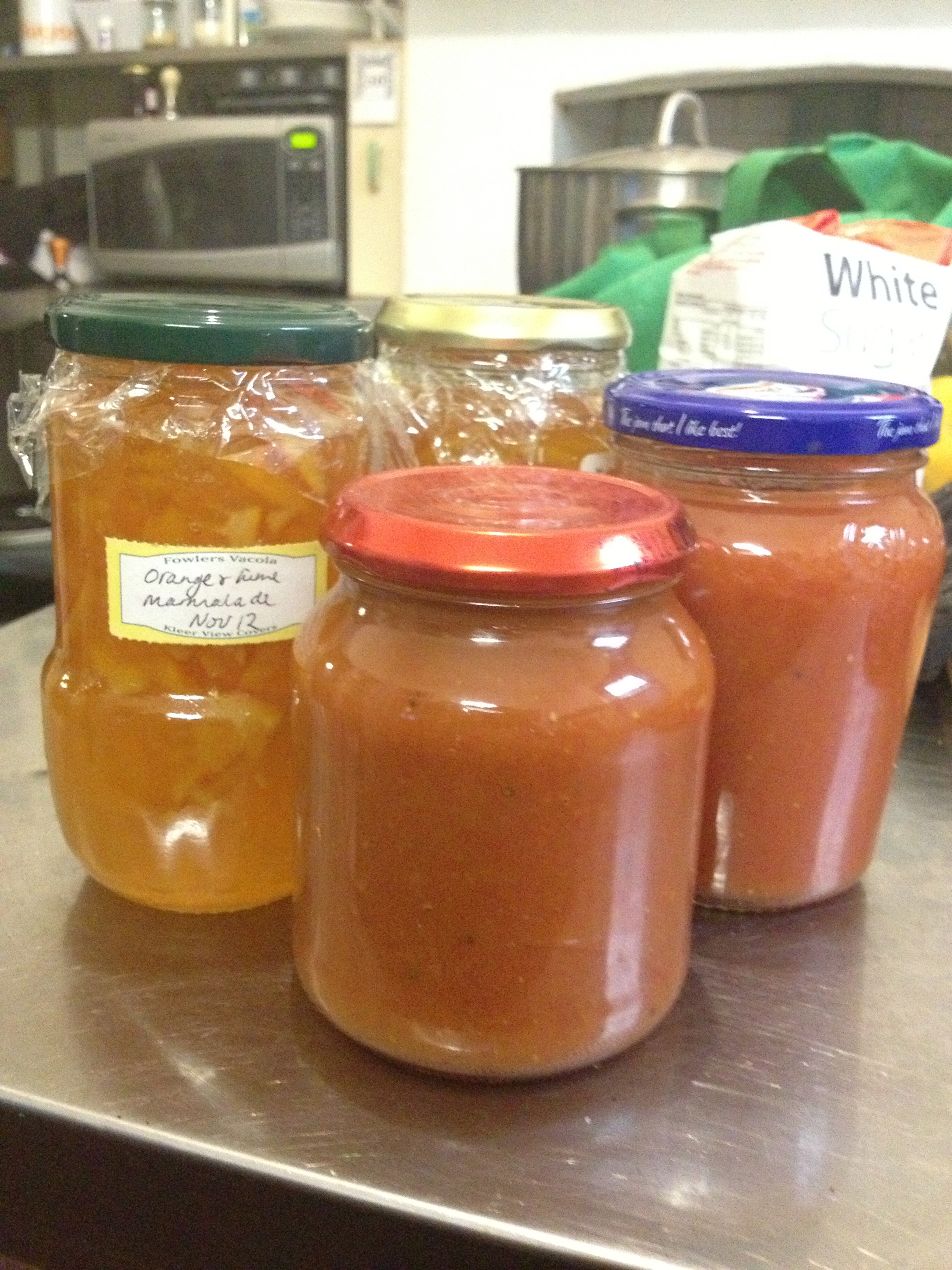
Orange marmalade and tomato passata

Elizabeth’s Great-nana’s guaranteed marmalade

  • 1lb citrus fruit, sliced very finely
  • 2 pints water
  • 3lb granulated sugar

Slice citrus finely and remove pips.

Put fruit and water into your jam pot and simmer until the fruit is soft – this is important as once you put the sugar in, no further cooking occurs.  If you don’t get the fruit really soft first up, your marmalade will be impossible to chew.

Put your jars and lids into a 120deg C oven to sterilise them.  It’s important that your jam goes into hot jars – hot jam into cold jars is likely to end in an explosion.

Once the fruit is soft, add sugar and boil to setting point.  To check setting point, put a dribble of marmalade on a saucer you’ve had in the freezer for 10 minutes.  Marmalade at setting point will crinkle when you push your finger through it.

Leave the marmalade to sit for 10 minutes.  This is also important – slightly cooled marmalade will mean your fruit is evenly distributed in the jar, rather than floating on the top.

Pour into sterilised jars, seal and label.

*1 pint = 600ml, 1 lb = 455g

We are planning on having another preserving workshop in February 2013, but in the meantime – Happy preserving!

Compost, worms and poo

Huge thanks to Barb who lent us her backyard and shared her wisdom about all things decomposing.  It was the fifth workshop put on by the TTG Kitchen Gardeners’  Society, part of a series on producing your own food, a key aspect of building a sustainable community.

There’s a lot said about compost – but really it’s about soil health and reducing waste.  It doesn’t smell (or if it does, you’ve got it out of balance and it’s easy to fix), isn’t dirty or dangerous, doesn’t have to take up much space, and is very good horticultural practice.

Image

Here’s Barb with her enormous pile of poo.  That is, horse poo, nicely broken down and ready to be added to her sandy soil where her vegetables will appreciate the boost of nutrients  and water-holding qualities it will provide.  When you add manure to your garden, that is, manure that doesn’t come out of a sealed plastic bag, there are a few considerations.

1. Its freshness – newly, erm, laid poo tends to be fairly strong and can burn plants, especially seedlings.  It’s always best to let it break down for six weeks or so before you add it to your garden bed.  Chook is the harshest, while horse, cow or sheep is milder, but it’s still a good idea to let it mature a bit.

2. Seeds the animal has eaten that have passed through intact – considering poo is an ideal growing medium, viable seeds of oats and wheat will sprout as soon as they can.  You can let them sprout then dig them in as green manure, or if you compost it aerobically, it should get hot enough to kill off any viable seeds.

3. Any residual medication with which the animal may have been treated – this is a hard one.  Worming formula, for example, will likely kill lots of the good organisms in your soil.  Your best bet is to source your poo from someone you know who doesn’t use these sorts of medications.

Image

Making good compost is a balancing act – nitrogen and carbon, wet and dry organic material, and making sure it’s aerated.  Lots of dry garden waste, such as these palm fronds need to be balanced by a high-nitrogen, moist ingredient, such as, well, poo.

Barb also introduced us to her worm farms and her bokashi bins.  She has a system set up with friends who fill the bokashi bins, which she picks up, replacing a full bin with an empty one every few weeks.  She then buries the bin’s contents, and uses the liquid as a foliar fertiliser and to help keep her drains clear.

Her worms take care of a lot of kitchen waste, but worms don’t like meat, citrus or oniony meals.  They need to be kept cool and moist, which can be a challenge in Perth.

The Kitchen Gardeners’ Society always has afternoon tea and shares produce.

Image

The compost and worms workshop fitted in nicely with TTG’s recent waste and recycling survey, in which a large majority of respondents said they’d like to reduce their waste.  Composting is an excellent way of using up organic scraps, feeding your garden and reducing landfill.  If you don’t have room in your backyard, a bokashi bin under your sink will allow you to deal with food scraps in a very environmentally friendly way. The bins and the starter culture are available from hardware stores and eco outlets.

Our next workshop is on preserving the harvest on Sunday November 4.  RSVP to guilfordkitchengardeners@gmail.com if you’d like come as numbers are limited.