Category Archives: Kitchen Gardeners

Each peach, pear, plum…. How to prune fruit trees

We didn’t spy Tom Thumb, but we did have a lovely Kitchen Gardeners meeting on pruning on Sunday 2nd March.  The workshop was led by Elizabeth, with much input from the other Kitchen Gardeners. The afternoon started with a cuppa, some nibbles and a chat, before Elle launched into the specifics of pruning and tree care.  This was followed by a demonstration on the fruit trees in Flo and Tristan’s backyard which got a much-needed prune.

Elle demonstrates how to identify which limbs need pruning and how to shape the tree

Elle demonstrates how to identify which limbs need pruning and how to shape the tree

Before we started pruning, we discussed the different tools required, and talked about safety and pruning hygiene.  Elle had a particularly snazzy set of tools, and Barb brought her trusty snippers and shears along too.  We also discussed Barb’s lemon tree and its miraculous recovery after the application of a fresh cow pat poultice…

Elle started with the mandarin tree, which was still young but already showing signs of neglect!  Although the tree had four small mandarins growing, the leaves revealed the tree had undergone some stress during the heat of summer, and needed a good watering and some trace elements.  There was also whipper snipper damage to the trunk: an excellent suggestion to protect the trees was the use of a piece of PVC pipe as a small collar placed around the base of the trunk.
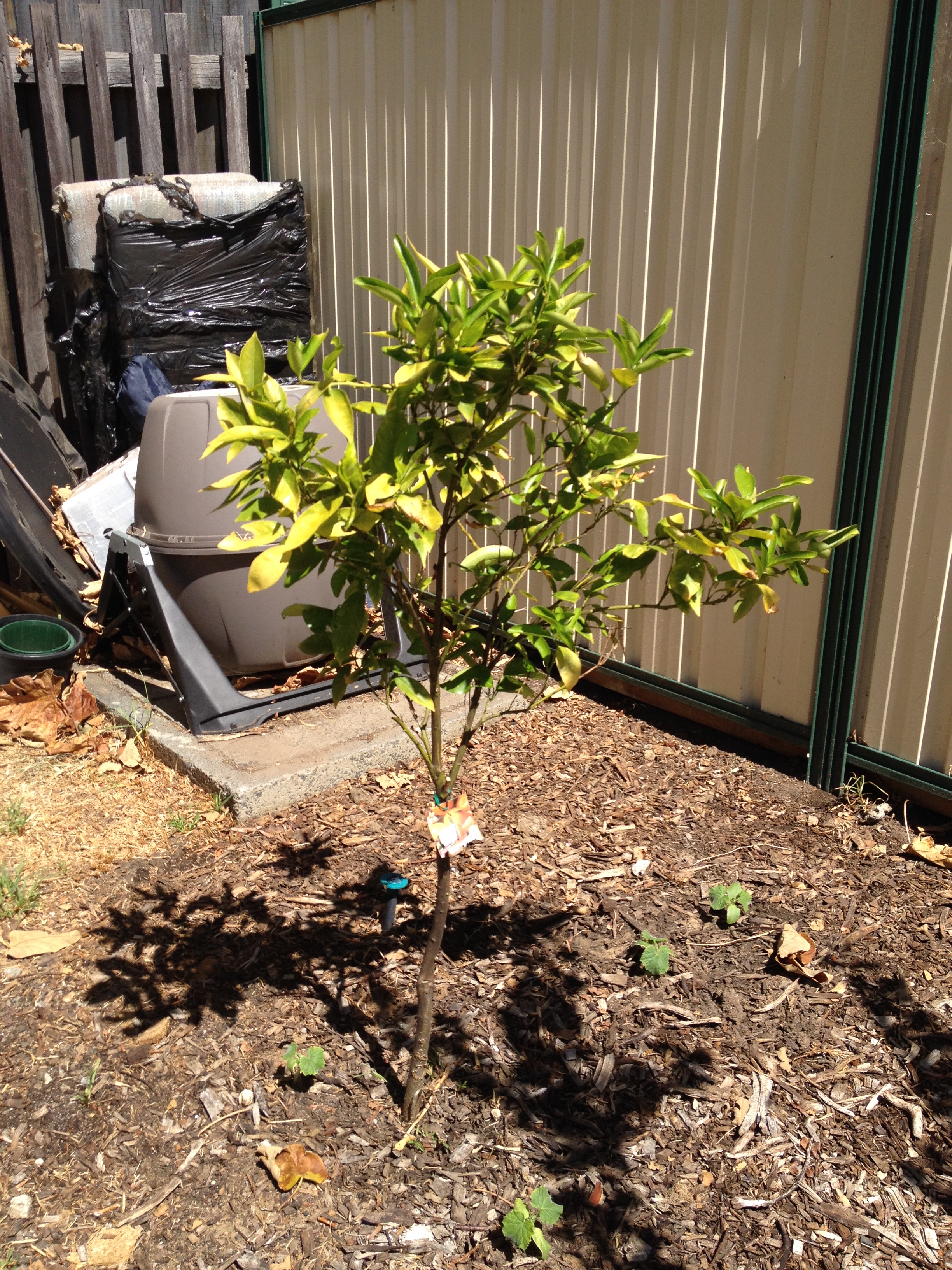
A week after pruning, the trees are clearly improving although mineral deficiency is still evident in pale leaves

A week after pruning, the trees are clearly improving although mineral deficiency is still evident in pale leaves

The diseased, dead and damaged material was removed to promote growth: new growth produces fruit.  The tree was pruned into a vase shape to allow more light and air into the middle area, thereby reducing fungal infection, allowing a better view of the tree for monitoring pests and improving access for pollinators. The vase shape may produce more fruit for less height on three or four main branches rather than one trunk.

Pruning can be done during any season, but winter pruning is best for revealing the form and shape of the tree when all the leaves are gone. The tree is dormant at that time, so the wounds take somewhat longer to heal compared to pruning after a tree has fruited.

The plumcot tree (a plum-apricot hybrid) was the next to be pruned, and here we discovered collar rot at the base of the trunk.  The advice was to move away any mulch touching the trunk, and to treat the tree with trace elements and Epsom salts.  Other than the collar rot, the plumcot tree was healthy growing vigorously.  Elle again chose to prune into a vase shape and reduce some of the tree’s height to make it more manageable.

The peach tree was a little more tricky. Unfortunately the grafted peach had died, leaving only surviving root-stock.  As the peaches being produced by the root-stock were not too shabby, we decided to perservere nurture the tree.  Normally the root-stock is pruned off, as this is usually unproductive growth that sprouts from below the graft. In this case, one branch from the root-stock was left while the rest from lower down on the trunk was pruned off.  Elle showed us how to prune by cutting on an angle to avoid water pooling on a wound or on wood and causing rot.

Other fruit trees that were pruned on the day included a healthy pear tree and two young citrus trees, a lemon and lime.  The plum tree was not pruned as it had suffered significantly during the summer and extra care and recuperation first. The olive tree didn’t need pruning as Flo had done this some time ago.

The afternoon was a great success, and much knowledge was shared.  Following the workshop, Flo applied all recommended treatments to the trees, including trace elements, extra watering, Seasol, and epsom salts. All trees, especially the plum tree, are clearly looking much better. Flo had some massive rockmelons and watermelons growing under the fruit trees, and during the week following the workshop these ripened and were picked.  There were 10 delicious rockmelons and five massive watermelons (the first one picked was 15.7kg!!)

Nothing beats home grown watermelon, seen here doing double duty providing shading to preserve soil moisture around the base of fruit trees

Nothing beats home grown watermelon, seen here doing double duty providing shading to preserve soil moisture around the base of fruit trees

Here are a few extra tips on pruning and tree care from Robert Brock:

  • To avoid collar rot, don’t mulch right up to the trunk.
  • Don’t mulch with wood chips or uncomposted mulches: as they break down they draw nitrogen from the soil.
  • Thick mulch all year round can suffocate the soil. Soil is alive: it needs air, water, food and light so that soil microbes can live. They create humus and wonderful rich moist colloidal soil.
  • Feed trees with well-decomposed compost spread around the drip line.
  • Too much of anything is bad: raw manures can force growth in a tree or plant, much the same way that artificial fertilisers do. The plant puts out new growth to restore balance from being overfed nutrients and minerals.
  • Don’t dig around your trees, you’ll damage the roots.
  • Feeding and watering the tree too much on the surface will encourage roots to remain at the surface. You want your tree to send its roots down for water, nutrients and stability. The roots anchor the tree: like a fence post, you want t bury them deep not shallow).
  • Artificial fertilisers and pesticides can disturb natural balance and lead to more problems. If you kill all insects then the wasps that eat scale and the lady birds that eat aphis will be gone too. Know which pests to watch for and how to control them, e.g. ants which can farm other pests such as scale.
  • Pests are only a problem when they are a problem: one or two spots of scale will cause little harm. In contrast, fruit flies can be highly damaging and should be exterminated with baits while ensuring timely removal and disposal of struck fruit.
  • There are several simple, effective natural remedies for a range of pest problems. Examples include soapy water for drowning aphids, and homemade white oil  which is easy to prepare and takes care of a range of pests.
  • Companion plant around your trees to attract beneficial insects and deter pests. For example, nasturtiums and citrus go well together as do hyssop and grapes, horse radish and apples.

Thanks to Elle our workshop leader, Florence our hostess and guess blog mistress, and Robert our expert tree pruning advisor. If you’d like to read more about pruning fruit trees, have a look here and here.

Sticky fingers

The first Kitchen Gardeners meet of the year wasn’t about wasting any time.

We got straight into it with a session on making jam and pickling beetroot.

jam and pickles workshopThanks so much to Dave and Joan for offering their kitchen.  Luckily, they are experienced jam-makers and picklers, because I’d underestimated the number of jars I’d need and Joan had a stash.

Otherwise we’d’ve had a lot of beetroot to eat in a hurry!


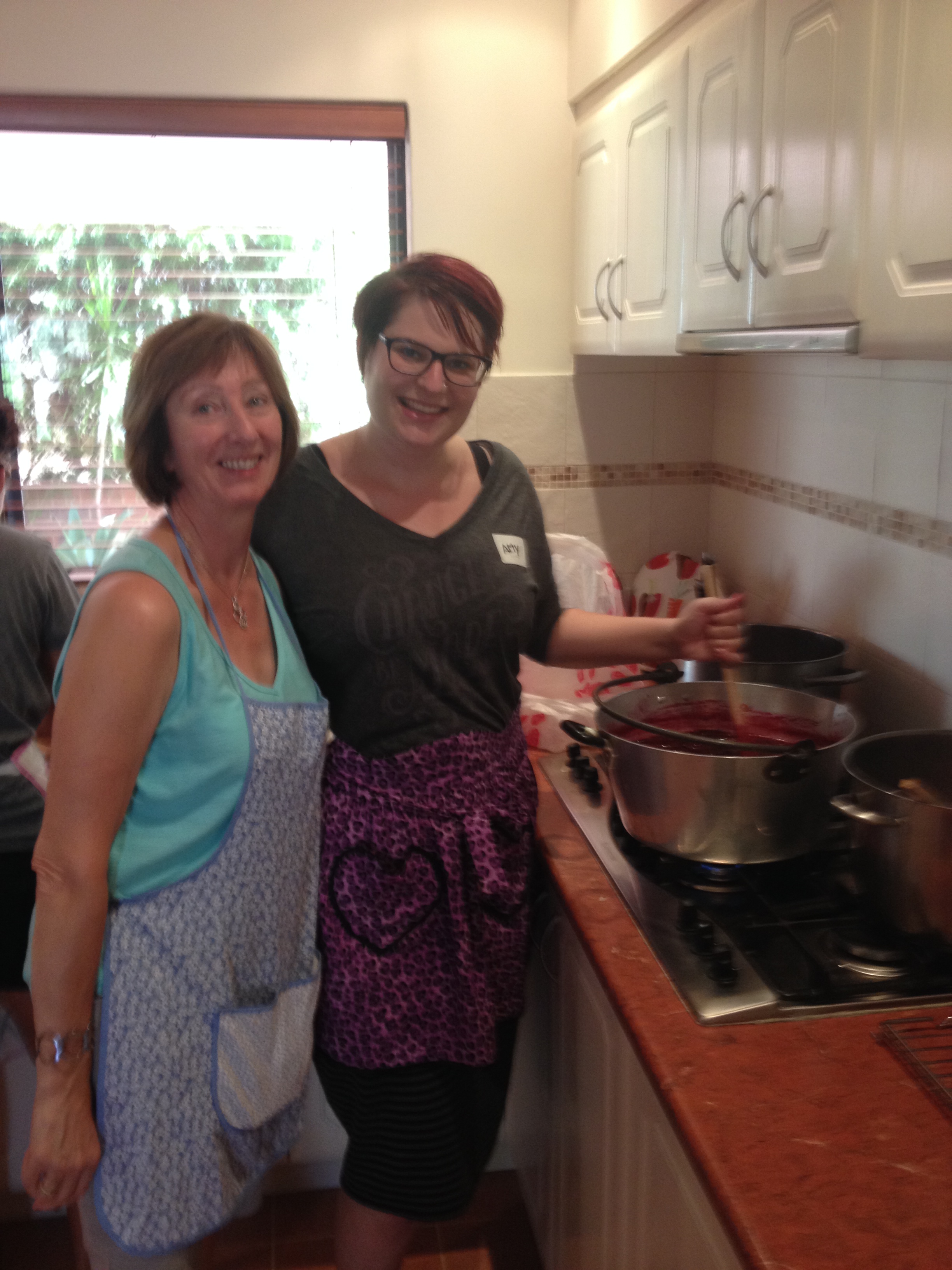
We all loved Amy’s apron – that’s her to the right of Joan.

Joan and Amy We used Elizabeth’s great-nana’s failsafe jam recipe and made blood plum and kiwifruit jam, which is agreeably tart and still sweet.

As we used both of Elizabeth’s heavy stock pots to simmer out beetroot (more on that later), Joan offered her nana’s jam pot for our jam.  What a beauty!

We’re sure nana would have approved of our afternoon.

Elizabeth’s great-nana’s failsafe jam

Ingredients

  •  Quantity of soft fruit (plums, strawberries, apricots, peaches…)
  •  Equal quantity by mass of sugar.
  •  Juice of a lemon.
  •  Commercial pectin (quantity by weight, one packet of Jam Setta to 1.5kg fruit)

Method

  •  Wash your fruit and cut it into equal-sized pieces, removing any stones, spots or yucky bits.
  •  Weigh your fruit.
  •  Weigh an equal amount of sugar, mix your pectin through this and set it aside.
  • At this point put your jars and lids in the oven at 100 deg to sterilise them.
  •  Put fruit in a large, heavy-bottomed pot on a very low heat.
  •  Let the fruit simmer very slowly until it is cooked.  This step is important, as once you add your sugar the fruit doesn’t cook any further.
  •  Once the fruit is cooked, add your sugar and increase the heat to a rolling boil.
  •  Boil about 10 minutes, then start to test for setting point.
  •  Once your jam has reached setting point, take if off the heat.  Let jam sit for 10 minutes or so, until the fruit no longer rises to the surface.  This will ensure that when you bottle it, the chunks of fruit are evenly distributed through the jar.
  •  Bottle, seal and label.
  •  Stand back and feel pleased with yourself.

Notes

  •  Pectin is the naturally occurring acid in fruit that aids in setting.
  •  Slightly under-ripe fruit is best for jam as it tends to contain more pectin.
  •  I usually guess with the amount of Jam Setta I use, depending on the type of fruit and its degree of ripeness.  It’s forgiving stuff.
  •  This recipe works for just about any soft fruit – the only failure I’ve ever had with it was with custard apple, and that was because it tends to be gritty.
  •  Setting point is the point at which the fruit soup changes its chemical consistency to a gel.
  • To test setting point, put a saucer in the freezer. When the fruit has been boiling for 10 minutes or so, put a smear on the cold saucer, put it back in the freezer to cool down quickly, then run your finger gently through it.   When the jam creases, it’s at setting point. You might need to do this a couple of times.  If you leave it past this you end up with toffee.

Pickled beetrootThen we pickled our beetroot.

This recipe won Elizabeth an OTT rosette at last year’s Swan View Show.

Hence the name.

President’s choice pickled beetroot

Ingredients

  • For about four fresh beetroots
  • 1 and ½ cup (375ml) vinegar
  • I bay leaf
  • Several peppercorns
  • 1/2 teaspoon salt
  • 1 cup sugar

Method

  • Wash the beetroot and place them in a saucepan. Add enough cold water to cover the beetroot. Bring to the boil and cook until the beetroot are tender.
  • At this point put your jars and lids in the oven at 100 deg to sterilise them.
  • Drain beetroot reserving 1 and 1/4 cups (300ml) of the cookingliquid.
  • Once the beetroot are cool, cut off the tops and bottoms and peel. Slice the beetroot and set aside.
  • Mix together the reserved cooking liquid and the vinegar in a saucepan and bring to the boil.
  • Add the bay, pepper, salt and sugar to the saucepan. Stir occasionally and bring to the boil again. Remove from the heat.
  • Place beetroot slices in your jar and pour hot vinegar mixture over the top.
  • Use a cellophane sheet under the lid to seal, and store in a cool,
  • dark cupboard for a few days before eating.

Getting your garden through a Perth summer

It’s hot, isn’t it?  And dry. Very, very dry.    Yup, that’ll be summer and even though we know it’s coming, it’s still rather a shock when it hits.

Fortunately there’s a lot you can do to help your garden withstand the season.

IMG_1637  Let’s assume you’ve already done some work on your soil.  If you’re on clay, you’ll want to have dug in lots of compost, gypsum to help break down the clay, and manure.  The good thing about clay is that it tends not to repel water in the same way sand does, but once it dries out, you’re dealing with rock.  If you haven’t improved your clay by now, leave it til there’s decent rain.

If you’re on sand, you should still be able to dig it, but you’ll find water runs straight through it and no matter how many watering cans you empty onto a patch, the sand remains dry.  Not good for plants.  You’ll want to work on a smallish patch at a time, digging in Soil Solver/Sand Remedy, compost, manure and a wetting agent all at once.  It’s expensive, but worth it.

IMG_1638

When you’re planting your garden, keep your plants grouped according to their watering needs.  Some areas of your garden will need daily soaking, but others might cope happily with once-a-week attention.

Make good use of trees for gentle dappled shade – plants labels that say full sun, rarely mean Western Australian full sun.  If you can shelter smaller plants, especially veg from the blistering afternoon rays, you’ll still get a decent crop.  Deciduous fruit trees are particularly good for this.

Likewise shadecloth can mean the difference between scorched earth and a harvest.  The nurseries use white or beige year-round, but darker stuff is good for the nastiest of summer so long as you take it down as things cool off.

IMG_1639

Lastly – mulch.  And more mulch.  Pea straw is excellent so long as it you can stop it from blowing away, and you get bonus peas.  If you use chipped up trees, put manure down first as the chip mulch will leach away lots of nitrogen from the soil, and that’s what you need for lush leaf growth.  Be careful of find sawdust as it can set hard.  Coffee grounds won’t stop a lot of evaporation but they will make snails and slugs think twice about snacking on your seedlings.  Stay away from black jungle mulch (the black is artificial, sometimes provided by petrochemicals), choose coconut fibre for choice.

And of course, choose your species wisely.  Tomatoes, capsicum, silverbeet, pumpkins, squash and melons thrive in summer.  Wait until it cools off before you put in your potatoes, leeks, onions, herbs, cabbages, caulis, peas and lettuces.

And autumn isn’t too far away…