Category Archives: Energy

100% Renewable Energy Forum a Hit

On August 22 Transition Town Guildford and Hills Sustainability Group hosted an eastern suburbs forum on the Greens “Energy 2029” plan. The forum was an outstanding success, with standing room only at the Old Midland Courthouse. Over 60 interested and concerned people attended what was alternately an interesting, thought provoking and alarming evening. We apologise to the many people who tried but could not get tickets to this event. We will book a larger venue next time!

Energy1

Senator Ludlam explains Energy 2029 plan to a packed Old Midland Courthouse.

MC’d by our own Barb Frey, the first speaker was Greens Senator Scott Ludlam. Senator Ludlam briefly outlined the well-known issues around climate change and our energy greedy society before moving on to solutions to the problem. In 2012 the Greens commissioned SEN (Sustainable Energy Now) to carry out a detailed technical analysis of the electricity grid in Western Australia’s southwest with the objective of determining if it could be run entirely using renewable energy.

The answer is YES…..and it can be done by 2029.

Senator Ludlam was followed by Steve Gates from SEN with a technical but accessible explanation of how this could be achieved. The major problem with renewables in the past has been that they have difficulties supplying electricity continuously such as at night or when the wind doesn’t blow. These problems have been overcome by using a mix of technologies across the grid that essentially store energy during periods of excess allowing it to be used during periods of shortage. These are:

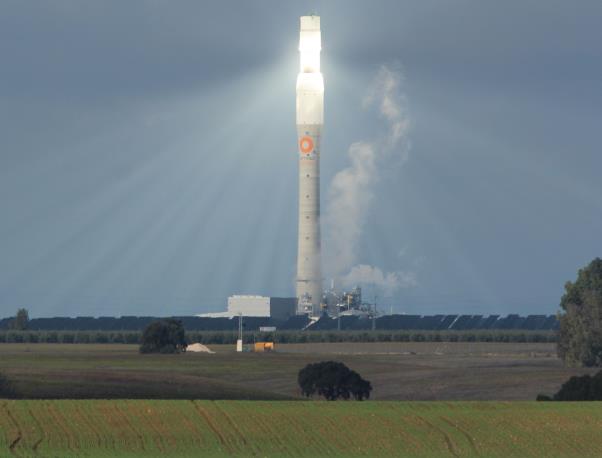
  • Concentrating Solar Thermal (CST). Those towers surrounded by mirrors that can also store heat for days as molten salt.
  • Solar Photovoltaic (PV). The friendly solar panels adorning so many of our homes.
  • Wind energy. Wind turbines.
  • Wave energy. Power generated from the movement of waves.
  • Geothermal energy. AKA “Hot Rocks”.
  • Bioenergy. Farmers earn extra income by planting native oil mallee trees that are used to generate power.
  • Pumped hydro. During sunny/windy days excess electricity from PV’s and wind turbines is used to pump water to elevated dams which are used to generate hydro-electricity when needed.
Energy2

The 19 MW Gemsolar CST plant in Spain.

All of these technologies are currently in use around the world and are rapidly decreasing in cost. They now challenge our current “dirty” fossil fuel generation systems in terms of capital cost even before health and environmental costs are considered.

I took two significant positive things away from the forum:
1. It can be done. The technology is available NOW and it is affordable.
2. The high turnout for this forum indicates a strong public interest in renewable energy and represents a demand for politicians to take immediate action to develop this type of plan.

Further details of the Energy 2029 plan are available here

Sustainable Energy Now (SEN) – http://www.sen.asn.au/

Hills Sustainability Group – http://www.hsg.org.au/
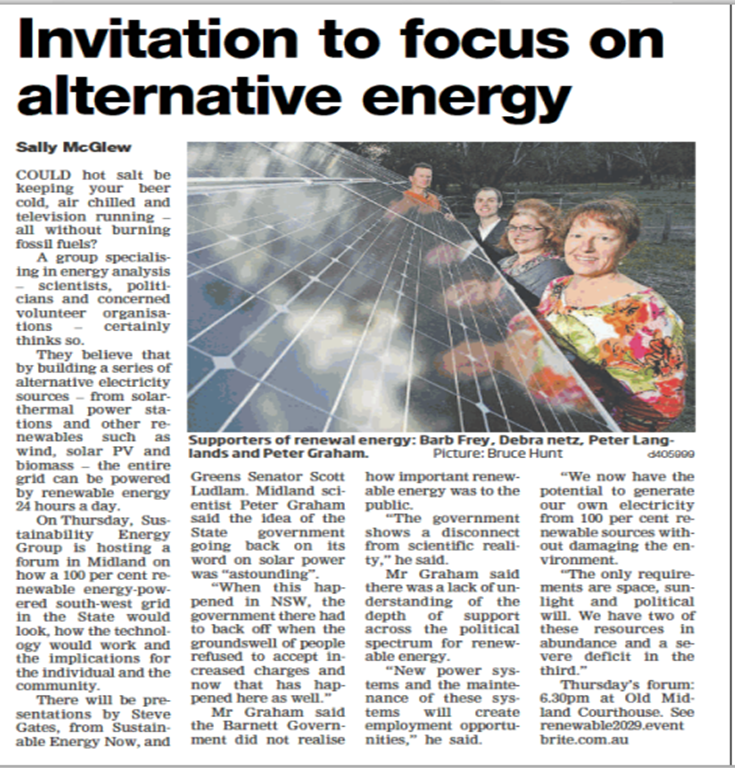
Midland Reporter article on the energy forum
Midland Reporter article on the energy forum

100% Renewable Energy Forum

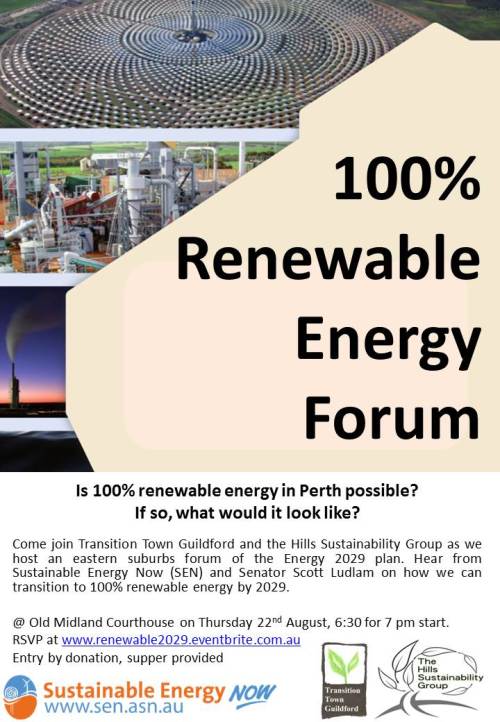
Renewable Energy forum poster

Is 100% renewable energy in Perth possible? If so, what would it look like?

Come join Transition Town Guildford and the Hills Sustainability Group as we host an eastern suburbs forum on the Energy 2029 plan. Hear from Sustainable Energy Now (SEN) and Senator Scott Ludlam on how we can transition to 100% stationary energy by 2029.

Prior to the March State Election SEN was commissioned by the WA Greens to provide a brief of scenarios which would demonstrate the potential for WAʼs South West Integrated System electricity grid demand to be fully met by a combination of renewable energy generation, efficiency, storage and demand-side management within the SWIS grid, by 2029.

Presentations by Senator Scott Ludlam, SEN secretary Steve Gates, followed by Q & A.

 Date: Thursday, 22nd August

Venue: Old Midland Courthouse, 43 Helena street, Midland

Time: 6:30 pm for a 7 pm start. Finish 8 pm.

Tea, coffee and supper will be provided.

Entry by donation

Presented in collaboration with:

Hills logo

About HSG: The Hills Sustainability group is made up of people living in the hills who are interested in environmental and sustainability issues. We have a mailing list of some 100 members and our goal is to encourage the community to adopt a more sustainable lifestyle.  We are an apolitical organization that wishes to work with the community and the Shire of Mundaring. We are not interested in adversarial dialogue on issues. We believe a conciliatory approach based on trust and goodwill will better serve the community. http://www.hsg.org.au/

SEN logo

About SEN: Sustainable Energy Now, Inc. is a community based think tank formed in 2007 with the aim to promote practical, affordable strategies for the adoption of renewable energy toward a sustainable global future. SEN has a broad membership of over 200 and supporters of over 1000 ranging from energy professionals, engineers, economists, doctors and academics to politicians, retirees and students. Our endeavours are to: Research; Promote; Advocate and Simulate the renewable energy potential of WA. http://sen.asn.au/

The WA State election and our four degree future

As a young adult living in WA I am dismayed to see the vast gulf between the latest climate science and observations, and the decisions being made by our State Government. Certainly, 2012 was a year of extreme climate events: the Arctic sea ice reached a new record low summer melt; the Greenland ice sheet experienced an unprecedented melt with 97% of its surface thawing over four days in July; temperature records tumbled around the world; and prominently, the USA suffered wildfires, drought and super-storm Sandy.

Here in Australia, we just experienced a January with seven consecutive days of national-average maximum temperatures above 39°C. This smashes the previous record of four days in 1972. Perth experienced a record eight heat waves last summer, while Perth metro recorded its 12th driest year on record and the driest July in 137 years, with just 34.6 mm.

Contrast this to the decisions being made in WA. The Barnett government removed all CO2 emission requirements for the Wheatstone and Browse basin projects, the impact will be equivalent to the emissions of 650,000 homes. These two LNG projects alone will increase WA’s emissions by more than 60%! And that’s not even taking into account the emissions caused by burning the fuel – that’s just from processing it.

Add to this, plans to develop unconventional onshore gas through hydraulic fracturing (‘fracking’). In November, the government signed an agreement to facilitate the exploration of the Canning Basin in the Kimberley, which is estimated to be the fifth largest reserve in the world. The development of that field could mean over 100,000 fracking wells across the Kimberley, not only adding to our climate woes, but potentially polluting water and degrading some of the world’s most beautiful landscapes.

Along with the decision to refurbish Muja  power station, which we recently learnt has experienced a cost blow out of over $100 million. Instead of locking in another 30 years of coal, how much renewable energy could have been built for a quarter of a billion dollars? Not to mention the demolition of the state Climate Change Unit and the release, after four years, of a State Climate Change Policy that has been described by prominent Australian scientist Ian Lowe as a ‘ten page picture book’.

Internationally, world governments have agreed that we must stay below a 2°C ‘guardrail’ of warming to avoid the worst impacts of climate change. Although we should note that, given the impacts we are now seeing with only 0.8°C of warming, most scientists now consider even 2°C unsafe.

A key question that faces us is: how much CO2 can we emit before 2050 to stay below 2°C?

Scientific studies have attempted to answer this question, with results suggesting that we can emit a further 550 Giga tonnes of carbon dioxide equivalent (GT CO2), if we are to give ourselves an 80% chance of staying below 2°C. With business-as-usual – that is, on our current emissions path – we’re likely to have used that up by 2026, nearly 25 years ahead of schedule. This is why both the World Bank and accounting firm PricewaterhouseCoopers released reports late last year saying we’re heading for 4°C plus of warming. A catastrophic future to say the least.

Earth Burning

If that’s not scary enough, there’s another important question to ask: how much CO2 is contained within the currently known reserves of oil, coal and gas? The answer is that there are over 2795 GT of COequivalent in known reserves. More than five times what we can ‘safely’ release!

This has massive implications for fossil fuel companies like Chevron and Woodside. What if 80% of your product could never be burnt? Ever. The world’s second largest bank, HSBC, just released a report suggesting oil and gas multinationals could lose 60% of their market value, if we strive to limit climate change, as we must. Hence a recent campaign in the USA by 350.org to get public institutions, especially universities, to divest shares in fossil fuel companies.

It doesn’t much matter that gas emits less CO2 at the point of combustion than coal, as the International Energy Agency has noted that overall emissions associated with a “golden age of gas” would still result in exceeding our greenhouse gas budget in much the same way. All emissions count, and all emissions will push us closer to the edge of tipping points, where natural feedback loops take matters out of our hands.

Given these numbers, the implications for our current direction are huge. The decisions being made in WA have global consequences. So, what about the leaders of our state? Will they break the climate silence of this state election campaign? Will we hear discussion of these numbers? And most important, will there be meaningful action after the election? I hope so, our future depends on it.